
What marmorino is
Marmorino (Italian for “little marble”) is a decorative plaster based on slaked lime. In the traditional recipe, marble flour and fine marble grit are added to the lime: the finer the grain, the smoother the surface. Once applied, the wall reads as stone rather than paint.
The Roman architect Vitruvius already described a plaster of lime and marble dust laid in several coats. The technique was later developed by Venetian craftsmen — hence the name “Venetian plaster”, now used for a whole family of such surfaces.
How lime turns back into stone
Lime does not harden simply by drying. Over time it combines with carbon dioxide in the air and turns back into calcium carbonate — the same substance that limestone and marble are made of. This process is called carbonation.
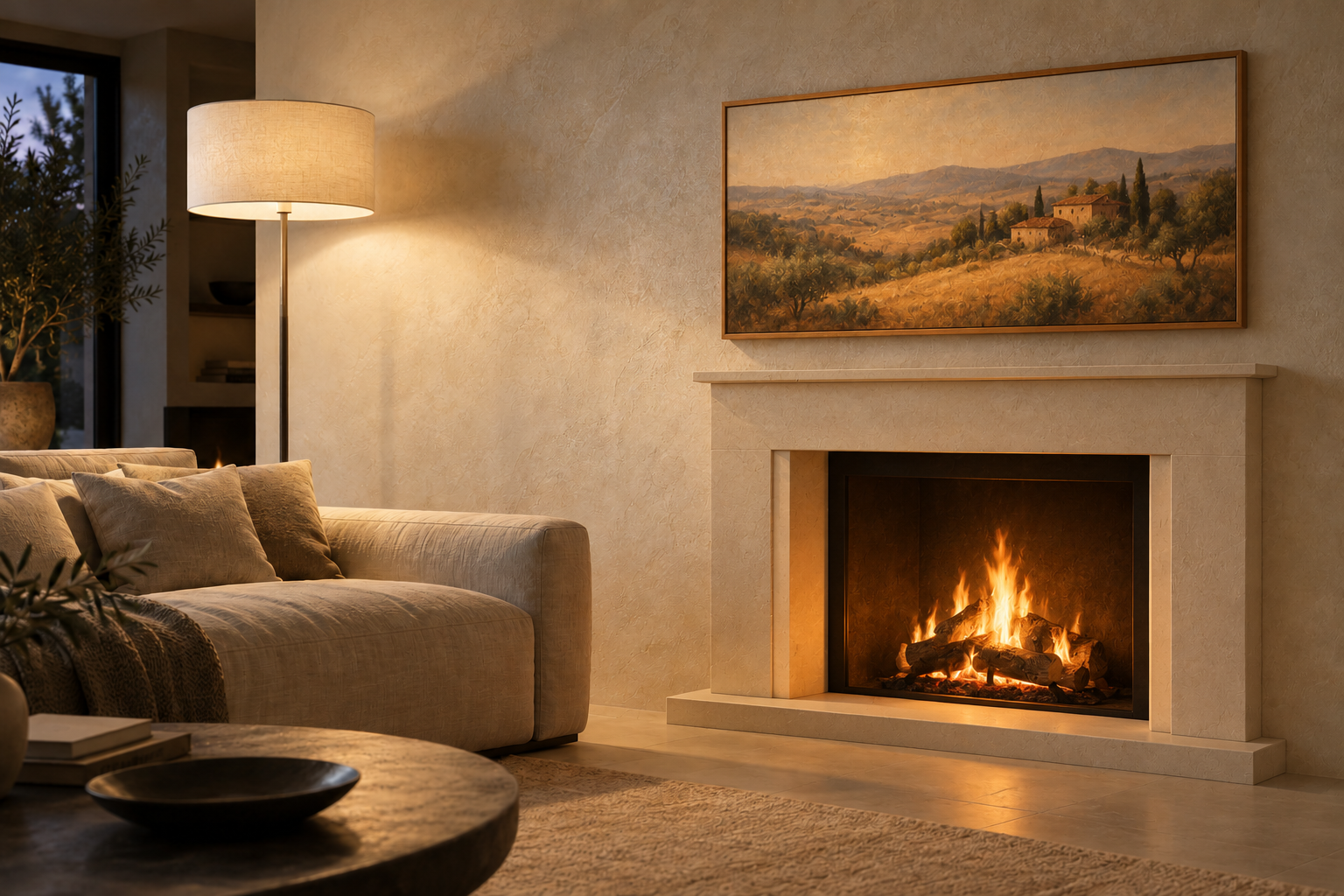
The carbonated layer explains why marmorino behaves the way it does in light. It is translucent: part of the light enters it, scatters on the calcite crystals and returns. That is why a lime wall looks deeper than a painted one, and why its tone shifts with the angle of the light.
Why movement on the surface is character, not a flaw
Marmorino is applied with a trowel, coat by coat, and the craftsman’s hand leaves its trace on the wall: the direction of each stroke, the soft shifts of tone. In direct daylight the surface is calm; in side light it shows movement. No two marmorino walls are alike, which is exactly why the material should be judged in person rather than on a screen.
How to choose marmorino for your space
- Start with the space. Where the wall is, where the light comes from, how the room is used by day and in the evening — this is what determines the shade and the level of sheen.
- Look at a sample in place. On-screen colour is not the physical colour. An A3 sample should be viewed in the room where the material will live, at different times of day.
- Decide about wax in advance. Wax deepens the tone and adds sheen, and once it has dried the decision cannot be undone. So it, too, is tested on a sample rather than on the wall.
Next step
Marmorino is lime that turns back into stone on the wall and holds light in its own way. To see how it will behave in your space, start with a sample.
Explore the Marmorino collection · Order a sample
Materials in this article: Marmorino